The UX of Zero-Knowledge: Understanding Scroll’s Architecture
Introduction

Scroll is a well-known Layer 2 solution that makes use of zero-knowledge technology. Imagine building on Ethereum without the constraints, no compromising on security, no sacrificing speed, no watching your users wince at gas fees. I believe in how Scroll has solved one of blockchain's hardest problems, making Layer 2 feel invisible. The best technology disappears into the background, and that's exactly what Scroll achieves with zero-knowledge rollups.
The Three Layers of Scroll

Scroll’s is built on three main layers, each with a distinct role in delivering secure and efficient transactions:
Settlement Layer (Ethereum): It means Ethereum provides data availability, ordering, and validity verification. Users and dapps can interact across chains through bridges. It is the backbone of trust and also the foundation on which the system is built that ensures every user action is reliably anchored to Ethereum.
Sequencing Layer (Execution + Rollup Nodes): Sequencer executes transactions and builds L2 blocks. The rollup node batches these transactions, posts data to Ethereum, and submits validity proofs. In design, this layer represents the “real-time” system, which handles user requests, organizes them, and ensures they reach finality efficiently. It helps in designing feedback loops and transaction status indicators that communicate trustworthiness to the user.
Proving Layer (OpenVM Provers): Here, the Provers validate L2 transactions without exposing sensitive data, and a coordinator manages proof distribution, meaning the layer that gives users privacy and security without requiring them to understand the underlying cryptography.
Designing for Ethereum Compatibility
Scroll uses Ethereum's account architecture, which includes externally owned accounts (EOAs) and contractual accounts that store state using a Merkle-Patricia Trie (MPT) and is completely compatible with Ethereum. Scroll will go unnoticed by Ethereum natives unless something goes wrong. It hides complexity while emphasizing critical trust signals like transaction finality and evidence verification.
The Rollup Process
Scroll’s rollup workflow can be broken into three phases:
Transaction Execution: This means the users submit transactions, which are queued and processed. Which means in design, it communicates the queuing and execution process clearly, allowing users to feel in control, not left guessing about pending states.
Batching and Data Commitment: Transactions are batched and posted to L1. In user experience, batching is undetectable; however, finality indications can indicate reliability, which means it avoids overwhelming consumers with superfluous technical details; instead, it displays progress states such as "Transaction included in batch."
Proof Generation and Finalization: Zero-knowledge proofs validate batches on-chain, in which Users get privacy and correctness, and the experience should be frictionless. Feedback should be simple: “Your transaction is verified” without showing the raw cryptography.
Scroll as a zkEVM
Scroll’s core is the zkEVM, which proves that off-chain EVM computations were executed correctly. This allows Scroll to maintain Ethereum compatibility while benefiting from zero-knowledge scalability.
Execution Trace: Each transaction is broken into opcode executions that collectively form a proof.
Proof Aggregation: Scroll layers proofs into chunk, batch, and bundle proofs.
OpenVM: A general-purpose RISC-V zkVM simplifies auditing and reduces proving latency.
Generally, zkEVM is a design opportunity because it allows near-instant transaction confirmation with cryptographic guarantees.
The Evolution of zkEVM Evolution
zkEVM is a system that proves correct EVM execution, which helps to solve one of blockchain's grand challenges. EVM wasn't designed with zero-knowledge proofs in mind, yet Scroll has been at the forefront of making it work.
Scroll's approach to zkEVM has evolved significantly:
Early Development (2021-2024): Custom EVM circuits proving each opcode directly, developed in collaboration with Ethereum's Privacy and Scaling Explorations team.
OpenVM Prover (2025-Present): The Euclid upgrade introduced OpenVM, a general-purpose RISC-V zkVM developed by Axiom. This architectural shift is transformative:
Proves standard Rust code instead of custom circuits
Simplifies auditing and enables code reuse
Reduces proving costs and latency
Eliminates circuit capacity constraints
Made Scroll's Stage 2 rollup status possible
How Transactions Flow Through Scroll
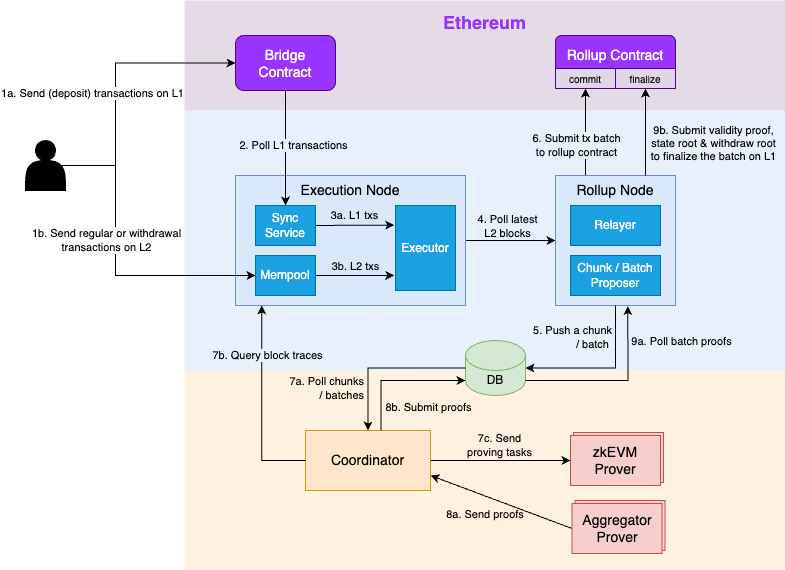
Understanding the rollup process helps appreciate Scroll's elegance:
- Transaction Execution
Users submit transactions to the L1 bridge or the L2 sequencers
The sync service fetches L1 transactions from the bridge
The sequencer processes transactions from both queues to construct L2 blocks
- Batching and Data Commitment
The rollup node monitors L2 blocks and collects transaction data
When criteria are met, it proposes chunks (collections of blocks) or batches (collections of chunks)
The relayer submits commit transactions to Ethereum, establishing data availability
- Proof Generation and Finalization
The coordinator dispatches proving tasks to the prover pool
Chunk proofs verify individual segments; batch proofs aggregate them
Once complete, the relayer submits finalized transactions with validity proofs to Ethereum


